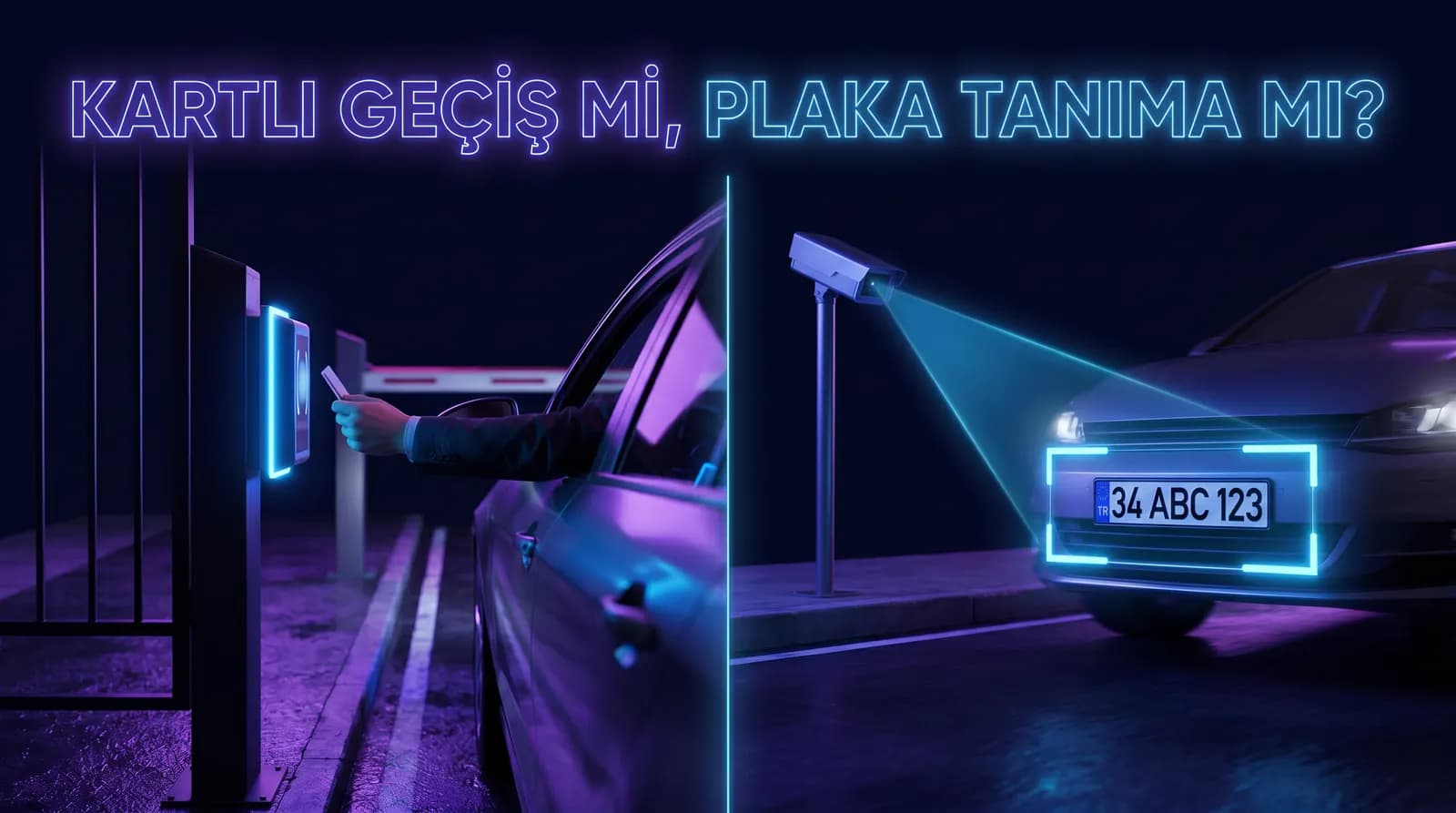
Comparing card/remote access control and license plate recognition for residential sites and parking lots — cost, security, visitor handling and reliability. Which fits your facility?
When planning access control for a residential site or parking lot, the choice usually comes down to two options: card/remote (RFID) access or license plate recognition (LPR). Both open the barrier automatically, but they work very differently day to day. This guide compares the two across seven concrete criteria and shows which one — or which combination — fits which type of facility.
How Card/Remote (RFID) Access Works
In an RFID or remote-control system, each vehicle or user is issued a physical credential: a magnetic card, an RFID tag/sticker, or a remote control. When the vehicle approaches, a reader antenna scans the credential, the control panel checks it against its database, and if it matches, the barrier or gate opens. It's a mature, well-understood and relatively inexpensive technology.

How License Plate Recognition Works (Briefly)
With LPR, the credential is the vehicle itself — no card or remote is needed. A camera captures the plate, AI-based software reads it (OCR), compares it against the authorized list, and triggers the barrier accordingly. The whole process takes under a second, and the driver doesn't have to do anything — not even roll down a window.
Seven-Criteria Comparison: RFID vs. LPR
1. Loss, Cloning and Unauthorized Transfer
This is the most common operational headache with card systems: cards and remotes get lost, forgotten, cloned, or handed off to someone who isn't authorized. A large share of day-to-day site-management complaints are "my remote stopped working" or "I lost my card." Every lost card means reissuing, deactivating the old one, and a handover process — cost and operational overhead.
With LPR there's no physical object to lose, clone or hand off; the credential is the plate itself. When a vehicle changes hands, removing it from the authorized list is enough — nothing physical needs to be recovered.
2. Visitor Management
With card systems, a visitor either gets a temporary card/remote or a guard opens the gate manually — both add friction and delay. With LPR, a guest vehicle is logged temporarily or an "unlisted vehicle" procedure (alert, operator review) kicks in, with no physical credential to hand out.
3. Setup and Maintenance Cost
Card systems typically have a lower upfront cost (reader + panel + per-card unit cost), but as the user base grows, the recurring cost of cards/remotes adds up, and lost/damaged card reissuance is an ongoing line item. With LPR, the hardware side is camera + software license; adding another authorized plate is a software operation with no incremental hardware cost per user.
4. Audit Trail
Card systems log that "card 34" entered, but can't guarantee who was actually carrying it at that moment — cards get lent out or transferred. With LPR, every entry is tied to a specific vehicle with visual evidence, which makes later reviews (disputes about who entered when, post-incident investigation) more reliable.
5. User Experience and Throughput
For a known, fixed user base (e.g., a staff parking lot), RFID cards are fast and dependable — just approach the reader. With LPR, the driver does nothing at all, but throughput depends on camera angle, vehicle speed and lighting being set up correctly. A well-positioned LPR camera matches card-system speed without the driver reaching for anything.
6. Weather and Technical Reliability
RFID readers are largely unaffected by weather. LPR accuracy can drop at night, in heavy rain or fog, or with dirty/damaged plates — which is why choosing the right night-vision (IR/WDR) camera and correct positioning matters. With the right hardware, LPR systems run at high accuracy around the clock, but that reliability is a function of hardware choice.
7. Data Privacy and Compliance
Both systems process personal data (cardholder identity or vehicle plate). The difference is where that data is processed: cloud-based LPR systems may send images off-site, while offline systems like PlakaNet process everything locally — no image ever leaves the premises. For more on this, see our guide on GDPR-friendly license plate recognition for facility managers.
When Does a Hybrid (Card + LPR) Setup Make Sense?
Industry sources suggest RFID is a strong fit when most traffic is known and recurring (e.g., over 70% of daily traffic is registered users), while LPR fits better where guest/unknown traffic is heavy. That's why many facilities land on a hybrid model:
- Staff/resident vehicles: fast, known-user access via card or remote.
- Visitor/outside vehicles: LPR handles them automatically, with no physical credential to distribute.
- Redundancy: if a card reader fails or a card is forgotten, LPR can act as a backup verification layer.
In this setup, LPR software runs *alongside* your existing card system, not instead of it — both can trigger the same barrier via HTTP/TCP or relay.
Which Fits Which Scenario?
- Residential site (mostly residents, low visitor traffic): LPR alone is usually enough — residents pass automatically, visitors get logged. Lost card/remote complaints disappear.
- Commercial / paid parking (high turnover, mostly unknown vehicles): LPR is the natural fit — issuing a card to every driver isn't practical; entry/exit time is measured automatically and billed by tariff.
- Factory / logistics (mixed staff and truck/supplier traffic): a hybrid model works well — staff on cards, outside vehicles (trucks, suppliers, visitors) on LPR.
- Shopping malls / hotels (heavy, mostly unfamiliar visitor traffic): LPR is the only realistic option where distributing and collecting cards isn't feasible.
FAQ
Do I have to replace my existing card system entirely?
No. In most installations, LPR is added as an extra trigger layer on top of the existing barrier/gate automation via relay or HTTP/TCP, while the card system keeps serving staff/residents.
Is LPR more expensive than a card system?
It requires an upfront investment in cameras and a software license, but doesn't add recurring costs like card printing or reissuance as the user base grows. Total cost of ownership depends on facility size and user turnover — see our pricing guide for a detailed cost comparison.
What happens with plates that can't be read (dirty, damaged, foreign)?
A well-configured system falls back to the facility's defined procedure for unlisted/unreadable vehicles: alert, operator review, or manual entry — no different from the process for someone who forgot their card.
Can I run both on the same barrier?
Yes. Barrier/gate control units typically accept multiple trigger inputs; a card reader and LPR software can each open the same barrier independently.
Conclusion
Card access remains a solid choice for facilities with a known, fixed user base. But wherever visitor traffic is heavy, lost/cloned cards create operational overhead, or you want automatic, visually-verified logging, LPR offers a clear advantage — reflected in the fact that LPR has become the largest single share of parking-management revenue industry-wide. PlakaNet's fully local/offline AI-based LPR software can sit alongside your existing card system or replace it, depending on what your facility actually needs.