Learn how to select an LPR camera by evaluating angle, lens, IR lighting, shutter, WDR and a practical field acceptance test.
The most expensive camera in a license plate recognition project does not automatically produce the best result. What matters is the plate size in the image, the angle between camera and vehicle, vehicle speed, night illumination and the quality of the stream reaching the software. That is why “How many megapixels do I need?” is not a sufficient question. Ask instead: “Can this camera capture readable plates in my lane and under my conditions?”
This technical guide gives parking, residential, factory and campus teams a repeatable way to choose an LPR camera and carry out an acceptance test. It focuses on measurable image conditions rather than a brand recommendation or an absolute megapixel claim, so it can be used to assess an existing camera as well as a new investment.
Classify the Use Case First
“License plate recognition” does not use one universal camera setup. At a barrier, a vehicle slows down; on a free-flow lane it may pass farther from the camera and without stopping. Lens choice, exposure, capture distance and triggering differ accordingly.
- Barrier access control: vehicles approach at a controlled speed. The objective is a reliable, fast decision against an authorized list and an automation trigger.
- Slow free-flow traffic: cars may not stop, although lane direction is predictable. Capture distance and motion blur become more important.
- High-speed road traffic: may require dedicated ANPR hardware, suitable optics, strong lighting and a different solution architecture. Do not assume an entrance camera will deliver this performance.
PlakaNet can process RTSP/HTTP IP-camera streams and USB-camera images for access-control cases such as sites and parking facilities. If your objective is high-speed traffic capture, first validate the camera manufacturer’s stated limits for that distance and speed.
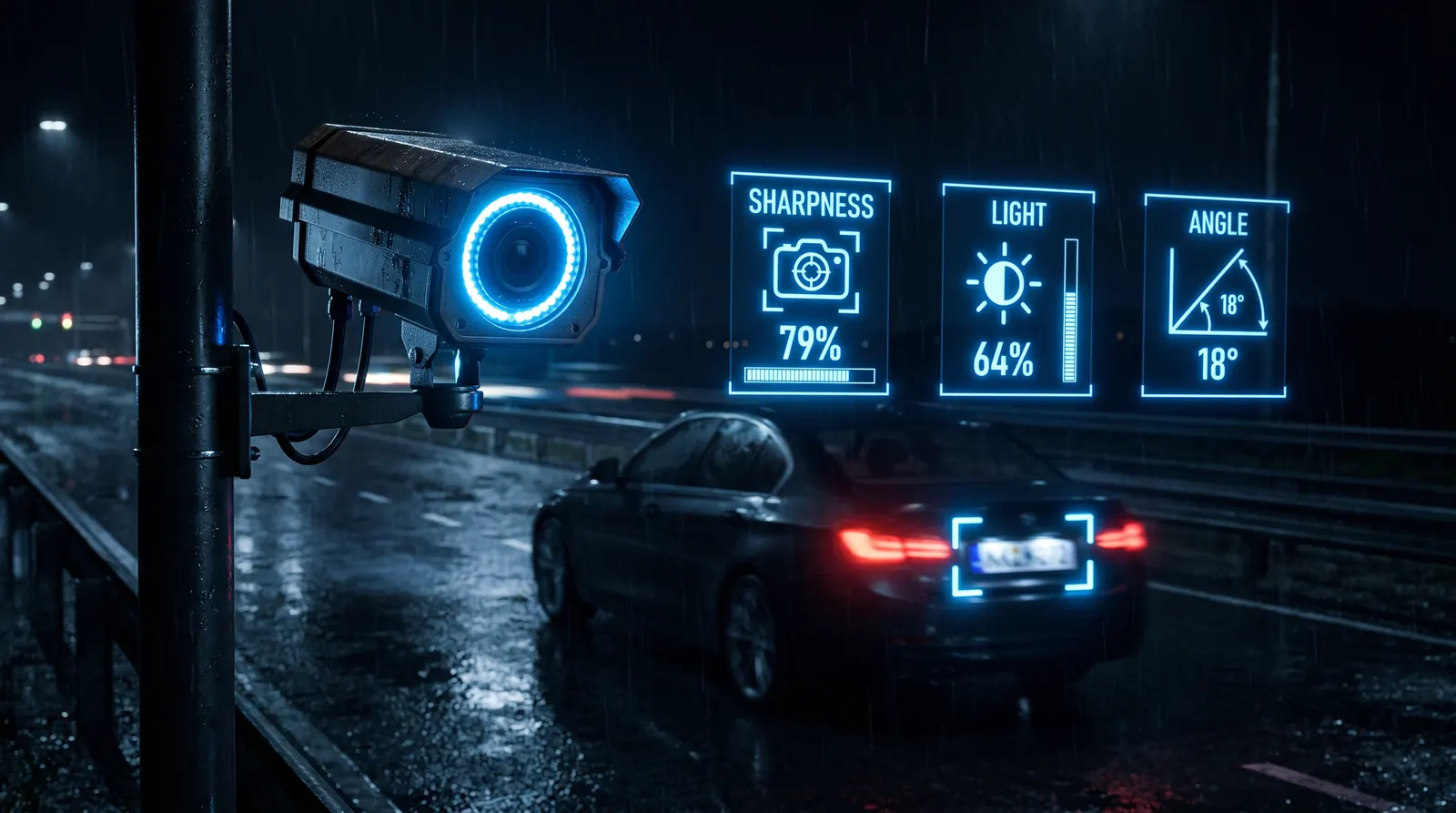
Plate Size in the Image Matters More Than Headline Resolution
Total camera resolution does not guarantee enough pixels on the plate. A 4K camera with a very wide field of view can show a plate as a tiny detail; a lower-resolution image with the correct lens can perform better. Measure the real plate width in pixels in the live view.
Manufacturer guidance uses different pixel ranges by product and scenario. Some ANPR references use roughly 70–250 pixels of plate width, while others give a higher example threshold for European plates. Treat these as starting points for checking framing, not universal rules. The right target is the size that produces an acceptable correct-read rate with your chosen camera, lens and OCR software in both day and night tests.
Practical check: take a live-stream screenshot with a vehicle on the intended capture line. If the plate is a small detail of the scene, review field of view and lens before simply increasing resolution.
Angle and Mounting Height: What Software Cannot Repair
Aim the camera as close as practical to the vehicle’s direction of travel. Axis and Hikvision plate-capture guides use a mounting angle below about 30 degrees in horizontal and vertical directions as a general reference. A plate should also appear horizontally aligned in live view; a tilted image distorts both the plate region and character shapes.
This does not mean mounting the camera at ground level. Choose the height together with the camera-to-vehicle distance. A higher camera increases vertical skew; a camera placed too far to the side increases lateral motion in the frame. Define a capture line where the car has completed its turn, the plate is not hidden by another vehicle and the driver can proceed safely.
- Avoid placing the capture point in the middle of a sharp turn, junction or ramp.
- Check direct sun into the lens at sunrise and sunset.
- With multiple lanes, validate the expected framing independently for every lane.
- If present, align the reading line with a barrier loop detector or another safe trigger point.
Night Capture: Balance IR, Exposure and Reflection
Night performance is more complex than the phrase “has IR.” A plate reflects light strongly. If IR illumination is too far from the camera, the reflection may not return well to the sensor; if it is too strong or poorly tuned, the plate can bloom and lose character detail. Axis recommends positioning external IR close to the camera and limiting maximum gain so the plate is not overexposed.
A long shutter creates motion blur when a car moves, especially when it moves across the image at an angle. A short shutter sharpens characters but lets less light reach the sensor. Night tuning is therefore a balance of vehicle speed, illumination and noise. Target the image that shows character detail most clearly, not merely the brightest image.
Wide dynamic range (WDR) can help where bright and dark regions coexist, but some cameras create motion artifacts when WDR is used with moving vehicles. Do not assume WDR should always be enabled for plate capture. Test both states in the same passage scenario. Use the manufacturer’s plate-capture profile first if one exists, then refine settings based on evidence.
Checkpoints for Lens, Focus and Frame Delivery
A varifocal lens is useful for adjusting the frame after the survey, but it is not the right choice merely because it zooms. Check that it delivers focus at the target distance, sufficient night light transmission and the intended plate size. Even with autofocus, a setting that works during the day may not yield the same result at night or under IR.
- Measure the capture-line distance in metres.
- Record the expected maximum vehicle speed and direction.
- Document stream resolution, frame rate, bitrate and latency.
- Check whether packet loss, unstable Wi-Fi or aggressive compression destroys character detail.
- Keep the camera clock and the Windows device running PlakaNet synchronized; matching time matters in incident review.
Do not accept a setting by looking only at the browser preview. Test the same setting in PlakaNet’s real RTSP/HTTP workflow and through the actual decision and event-log path.
Acceptance Testing: Separate a Purchase Decision from a Demo Claim
An acceptance test is not a demo video. It is a small, measurable experiment that represents conditions at your property. Before starting, write down the success criterion and sample plan. Test entry and exit separately, at different times of day, with different vehicle bodies and normal real-world plate conditions. Keep the test within a safe traffic arrangement.
Record at least the following for each attempt:
- date/time, entry or exit lane, and weather/light condition;
- approximate speed category: stopped, slow or normal;
- whether the plate was read, whether the text was correct, and on which attempt;
- whether the plate was large enough in the image and whether glare or angle was present;
- time between the read and automation command;
- whether human intervention was required and why.
Do not summarize outcomes as a single success/failure number. Classify failures as angle, night bloom, motion blur, plate dirt, network delay or rule issue. The classification shows whether you need a lens change, camera relocation, lighting adjustment or more processing capacity before spending further money.
Technical Compatibility with PlakaNet
PlakaNet runs locally on Windows 10/11 and can process imagery from RTSP/HTTP IP cameras, USB cameras and test video sources. It uses YOLO-based plate detection and CCT-based OCR; GPU acceleration may be available depending on hardware. Measurements under suitable conditions have reached roughly 99% recognition; this is not a guarantee for every camera or site and must be verified during project acceptance testing.
During field acceptance, verify the entire chain: is the camera stream received, is the plate readable in frame, is the correct rule selected, does the HTTP/TCP trigger reach its target and can the event be found in the log? Improving the OCR engine alone may not solve a weak link anywhere else in the chain.
FAQ
Is my existing security camera sufficient for LPR?
It may be, but model name alone cannot decide it. Evaluate plate pixel size at the target distance, angle, night image, compression and the real stream. Better software cannot reliably repair unsuitable framing.
Are more megapixels always better?
No. Plate pixels in the frame, lens sharpness and night exposure matter more than headline resolution. A wide scene can leave the plate too small even at high resolution.
Should WDR be on for LPR?
It depends on the camera and scene. WDR can help with backlight but can introduce motion artifacts in some implementations. Compare on/off in the same day and night scenario and follow the manufacturer’s ANPR profile.
What should I check first when night reads fail?
First decide whether the plate is overexposed or motion-blurred. For overexposure examine IR placement and gain; for blur examine shutter, vehicle speed and illumination together.
Conclusion
The right LPR camera is not the highest number in a catalogue. It is the camera/lens/lighting combination that repeatedly produces readable plates on your own capture line. Reduce the angle, measure plate size in live view, test night settings and base the purchase decision on written acceptance data. That image foundation is the prerequisite for meaningful results from PlakaNet’s local AI detection, OCR, automation and reporting workflow.